Pages

Thursday, March 1, 2012

Everyone needs a bad day of golf

Some of us more than others experience a bad day on the golf course.


First off, I recognize that a bad golfing day is relative. Phil Mickelson has a bad day when he doesn't come home with an oversized check. A scratch golfer has a bad day when her handicap goes up. My dad, who as a rule doesn't like golf, has a bad day whenever his annoying son drags him out to the course.

For me, a bad day is when I play even worse than normal -- and normal is usually 40-50 shots over par. I started the year playing at Village Greens, about which I write here often. I thought my scores were on track for improvement. Here's what I shot so far this year at the par-56 course:

  • Feb. 21: 105
  • Feb. 24: 97
  • Feb. 27: 98

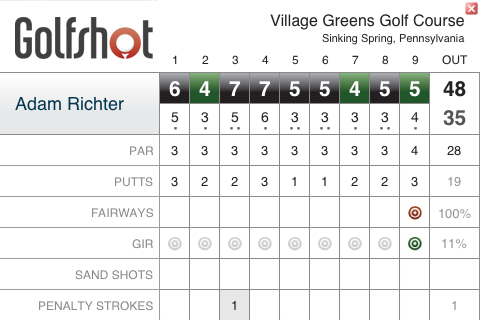
So today I went out again, to see if I could keep my score in the high 90s or -- dare I dream? -- break into the low 90s. I was on track through the first eight holes to keep it close. I double bogeyed on five holes, scored 7 twice and one 6. Then on the ninth hole, I lost any hope for a good (for me) game. My first tee shot on the 260-yard par 4 dribbled about 40 yards to the right. I tried a second tee shot that fared no better; it went into the woods on the next fairway.

I played my first shot, as I should have anyway. It came to rest about 3 inches behind a rock embedded in the ground. I swung with my 5-wood in faint hopes of getting some loft and hitting the ball over the hill so it would roll toward the green. Instead, it hit the rock 3 inches away, spun in the air and came down half a foot from where I hit it. In frustration I hit it again and it went into the woods.

This is where I decided to start over again. I teed up a new ball, which again went about 40 yards. This time I played my mulligan the whole way, taking six pathetic shots just to get it on the green, and another three putts to sink the ball. I ended with a generous 9 -- generous because I didn't penalize myself for the first balls that I lost.

After that I gave up. I played the back nine with just five clubs, abandoning any hope of playing well. The strategy worked, somewhat, because I bogeyed two holes and inexplicably made par on hole 12. Improvement was rare, however; I scored 24 on three holes, including the last two. So the back nine ended with 51.

The biggest problem, once again, is that I have trouble pitching. I also had trouble today hitting my 9-iron from the fairway. Every time I used it I topped the ball, causing it to limp a few yards along the ground. So instead of making the green in two shots, as I ought to be able to do, I would need three, four and sometimes five shots to make it.

I putted well enough to save myself on a few holes, but at that point, who cares? The difference between a 7 and a 6, even at my level, is insignificant.

So here's my scorecard from today's round. The consolation is that I can do better. Whether I do or not is anybody's guess.

Wednesday, February 29, 2012

Drive for show, putt for dough, and improvise on everything in between

Who would have thought that a golf game I played on the antepenultimate day of February would be my fifth -- FIFTH! -- game of the year? In the Northeast, weather has been practically nonexistent. Bad for the planet, bad for crops, but good for my golf game.
Regrettably, a beautiful day for golf.

So yes, I am personally benefitting in the short term from the destruction of the planet, but I do feel bad about it.

In the meantime, I played Village Greens on Monday, for the third time this month. The good news: The weather was perfect. (Sorry, earth!) The bad news: I showed no improvement over my last game. I scored a 98, one worse than the last time.

I should feel frustrated that my game didn't improve, but I was just happy that I stayed the same in two areas that have improved in the last few weeks: shots off the tee and putts. In short, the beginning and end of each hole are fine; it's the middle that causes me trouble. This is partly why I prefer to play at a par-56 course instead of a regulation course. A six on a par-3 hole is better than a 12 on a par-5.

Still, I accomplished just two bogeys for the round, and one of them -- on the 95-yard 13th hole -- I managed only because of a one-putt. I actually putted fairly well on the front nine, needing three putts on just three holes. The back nine was the reverse: I managed two putts or fewer on just three holes.
The site of my last bogey. For lousy golfers like me,
bogey is good.


The par-4 18th hole, a 305-yard uphill challenge was my undoing. Though my tee shot was fine and my third shot -- with a 5-wood about 100 yards from the pin -- landed on the green. But I muffed my second putt and it took me two more to hole out.

Here's my scorecard from Monday's round. I managed a symmetrical score: 49 on the front nine, 49 on the back. I still have a long way to go, but I'm reasonably confident I can keep my score in the double digits -- at a par-3 course, at least.

At a real golf course? I'd have to hope to keep it under 120. Make that 130. I'm still not nearly good enough to break 50-over par.


Saturday, February 25, 2012

Golf round - Village Greens, Feb. 24

Even on a rainy day, you have to keep on the sunny side. No matter how bad your game might be, focus on the positive.

You can't see it, but I totally hit the ball in the middle of the fairway.
Friday, for instance, I took pride in some unusually good putting. I played Village Greens -- which, as I often mention, is a par-56 executive course with just two par-4s. The best I ever did was a 90 in October. My most recent game was not that good; I shot 97, with not a single par for my efforts. But then, I make par about as often as Liam Neeson makes a joke. (Not often, in case you were curious.) I took solace in the fact that once I reached the putting green, I seemed to know what I was doing. A little.

I credit the "Complete Encyclopedia of Golfing Techniques" for my improvement. Over the winter, such as it was this year in the Northeast, I spent some time reading the book, laughing at the golf fashions (white belts? really?) and studying the tips for how to grip the club, how to stand and how to swing. The book provides basic advice on the swing, the short game, the putt and other areas, and basic advice is what I need.

Now I finally know where to put my feet, where to put my hands and how hard to hit the ball when I'm putting. Seriously. I never knew this before. So once I got the ball to the green, unless it landed six inches from the cup, it could take me one stroke or sixty to finish the hole.

On Friday I still had a few three- and four-putts, but on more than half the holes, I could finish with two putts (and in two cases, one putt).

The late great Harvey Penick deserves credit for this, as well. He wrote in his "Little Red Book" something about the first putt should be on a line to get close to the hole; the second should aim for the hole itself. I take that to mean, don't worry about sinking the ball on the first putt. Instead, use it to set up the shot that will get the ball in the hole.

So that's how I approach each green, and, with one exception -- I let frustration get the better of me and four-putted on the 10th hole -- I managed two putts or fewer on 12 of 18 holes.

In the overall scheme of things it didn't put a huge dent in my score. It's not like I shot a career best, and in many cases a two-putt made the difference between a triple or quadruple bogey. I only single-bogeyed on five holes, with no pars (let alone birdies) to my scorecard.


But it's a start. Now I can worry about every other aspect of my game.

Wednesday, February 22, 2012

A new season, same old scores

I used to think baseball was the ultimate sport for the stats geek. In the days before SportsCenter, you didn't need video replays to recap the action from the night before. The box score gave you all the information you needed to dissect what happened in the game. Only baseball fans could look at the six-inch-thick "Baseball Encyclopedia" and consider it a treasure instead of a doorstop.

(Fun fact: It works wonderfully as a doorstop.)

I used to go to baseball games with a bag of peanuts in one hand and a score book in the other. Why? Because it was fun.

My friends never thought so. I could never delegate the task of scorekeeping if I wanted to leave my seat for a bathroom break or another beer.

Thankfully I found golf. I can continue my nerdy fascination with breaking games into numbers and statistics. The main difference is that, unlike baseball, I'm not interested in how the pros do.

My scorekeeping interest has turned inward; I keep track of all my scores, my putts, my penalty strokes, my sand shots. Maybe in the jumble of numbers I will figure out how to improve.

Here in the Northeast we've endured a season that barely qualifies as winter. Barely 2/3 of the way through February, I've played golf three times this year.

The first time I was every bit as rusty and horrible as I was when I started the game anew last year. I played nine holes at a lovely course in southern Berks County called Chapel Hill. On the par-36 front nine, I shot 85. On the plus side, I got my money's worth from the course. (I also saw what I think was a fox, but it didn't see me.) I kept my score in the single digits on just four of the nine holes and sank two balls in water hazards.
The fox had no interest in retrieving golf balls from the water hazard.

On track for a 170 score!

A week later, I played Exeter Golf Course with my friend Chris. Maybe it was the social factor, but I improved by almost 20 strokes, shooting a 66 in nine holes. That includes five penalty strokes over the course of the game. Most of the time I hit into giant water hazards, and in one case I hit my tee shot into some poor soul's backyard.

No, I didn't play it from there.

Nine holes of golf might not qualify as an actual test of improvement over last season. And even if it did, those two rounds didn't show much improvement at all. So earlier this week I went to my usual course – the par-56 Village Greens in Sinking Spring – for my first 18-hole round of 2012.

It's an executive course, where all but two holes – 9 and 18 – are par-3s. But the par-3 holes range in distance from 95 to 190, so for beginning golfers like me, the course still provides a nice challenge. The last three times I played there in 2011 I managed to hit in the 90s, not including a 90 I achieved last October.
I like my fairways wide and forgiving.

But this week I still showed the rust of a winter layoff, ending with 105. The first hole didn’t bode well; I shot 7, taking five of those just to get to the green. After bogeying the second hole I struggled the rest of the front nine, getting mostly 7s and 6s, with a 9 on the par-4 ninth hole.

I didn't do much better when I started the back nine, scoring a six on holes 10 and 11, needing three putts to finish each one. But I bogeyed holes 13 and 14; on the former I two-putted and on the latter I hit the green from the tee. I ended with a 47 on the back nine, 11 strokes better than the front nine.

It's still not a great score – 47 is 19 strokes over par for the back nine – but now I know how bad my playing is at the start of 2012.


Nowhere to go but up, right? 

Wednesday, November 16, 2011

Black and white and green all over

"Who are you?" Scott asks when I tell him that I played two rounds the other week.

Scott's confusion is understandable. When I lived in Seattle, I played golf maybe -- maybe - once a month, less if possible. He knew me from those days, when my play was laughable and I wore my frustration on my sleeve. No wonder he was puzzled at my newfound enthusiasm for the game.

These days, I have even more gusto for golf than anyone would have thought possible. (Though I still can't bring myself to watch it on TV -- let's not go crazy.) I have recently discovered the joy of reading about golf.

Actually, writing that sentence, reading about golf sounds a lot less exciting than watching it on television. No matter. I stand by my decisions.

At a used book sale this weekend, I hit a goldmine of golf books. These should keep me busy during the offseason, which will start any second now.
Notice any similarities?
The giant "Complete Encyclopedia of Golf Techniques" is something I doubt I would buy new. But the price was right. I have no idea if it will be helpful.

As for the others, I'm particularly looking forward to these two:


As I have written before, my putting game is pretty awful -- well, not pretty but it is awful. So I hope these two books will help me in the offseason. 

As for the rest? There's the obligatory Harvey Penick series:

The golfing memoir:

The literary anthology:

And, last but not least, the collection of 19th-century golf writing, without which no golf library is complete. Note the faux-leather binding:

You shouldn't judge a book by its cover, and I didn't. I picked this up because of the sweet fabric-and-pewter bookmark in the middle.

Future blog posts on these individual books are almost certain. Meanwhile, what are some of your favorite golf reads? Discuss in the comments.

Tuesday, November 15, 2011

Here's to the bad golfers


I can't watch golf on television. I never could. Before I started playing golf, the flattened, boob-tube version seemed so boring. The announcers spoke too quietly, the audiences responded too softly and the action – following the arc of a white ball into what was often a gray or cloudy sky – too lazy.
"Of course you don't like to watch it; you don't play golf," my friends who did watch the sport on TV would say. "If you played, you'd appreciate it more."
He's probably not watching golf.
Except that now I play. And I still don't appreciate golf on television. I've tried watching The Golf Channel but it holds no appeal. All my reasons for disliking the televised version of the game remain the same, with one addition:

I'm more interested in bad golf.

I can watch football, basketball and baseball on television with great interest because I can't -- and don't -- play any of those sports. It's the same reason guys watch action movies. 
Allmoviephotos.com
Doesn't everyone want to be Tom Cruise?
The game's appeal is in its participation, the fact that anyone can get out and attempt to play, no matter how awful. Oh, and most of us are awful. If we weren't then we'd be the ones featured on Sunday afternoon television during the football off-season, sinking putts and hawking Buicks.

I'm not alone in this sentiment, and not even close to one of the originators of this idea. I was surprised to read that A.A. Milne, the creator of Winnie the Pooh, was a terrible golfer. But did he let this get him down? Of course not. The man fought in World War I, for crying out loud. Instead, Milne celebrated the sport because it lets people like him (and me) participate. No other sport, he said, allows you to be quite so awful. He wrote this in his essay, "TheCharm of Golf," in 1919:
"Consider what it is to be bad at lawn tennis. True, you are allowed to hold on to your new racket all through the game, but how often are you allowed to employ it usefully? How often does your partner cry "Mine!" and bundle you out of the way? Is there pleasure in playing football badly? You may spend the full eighty minutes in your new boots, but your relations with the ball will be distant. They do not give you a ball to yourself at football.
"But how different a game is golf. At golf it is the bad player who gets the most strokes. However good his opponent, the bad player has the right to play out each hole to the end; he will get more than his share of the game. He need have no fears that his new driver will not be employed. He will have as many swings with it as the scratch man; more, if he misses the ball altogether upon one or two tees."

Well put. I can hardly believe this is the man who once prompted the great Dorothy Parker to declare in a book review of Milne's "The House at Pooh Corner": 
"Tonstant Weader fwowed up."

She should have seen him play.

What's the appeal of watching golf on television? Inquiring minds want to know.

Monday, November 14, 2011

Almost ready for the big-boy courses


The last time I played a course longer than Village Greens, a public course with 16 par-3s and two par-4 holes, since Sept. 16. That's when I hit a pathetic (even for me) 87 on the front nine at a course in Lancaster County and decided, then and there, I am not fit for the courses where actual golfers play.
What a day for fair-weather golfers.

So since then I've made it my mission to practice at a short course, without the intimidation of par-5 holes, dog-legs and water hazards. Even the par-56 Village Greens is a challenge for a novice like me. To even break into the single digits, I still would have to hit 43 over par.

Hardly the stuff of PGA legends.

Still, I've been able to stay in the 90s pretty regularly, in the last month. In my three rounds since Nov. 1, I've shot no higher than 99.

Which brings me to today's insight. I am trying to not worry about improvement, and just enjoy playing.

In my brief golfing career I have learned not to keep track of my score from hole to hole. Today provided a great lesson why. I began the day with a beautiful, arcing 5-iron shot from the first tee that landed a short pitch from the green. It could have been an easy bogey, assuming I could get on the green in my next shot and two-putt the hole. Instead, my pitch shot went two feet. The third shot past the green, too far to try putting it on from the fringe. So I pitched it again, this time getting it 20 feet from the hole.

That number – 20 feet – comes into play later in this round. Keep an eye out for it.

I couldn't even salvage a two-putt, needing instead to take four putts to sink the ball. I don't have the best putting game, but on the first hole I was unusually bad.

The second hole was almost the same story, but with a slightly better outcome. I hit the 5-iron again from the tees, 120 yards away, and this time overshot the green. This time a decent pitch got me on the green, but far from the hole, and I had to putt four times to sink it. For the first two holes, I was already at 14.

OK, I thought. Guess I'm not breaking 100 today. C'est la vie (French for, "I hate this stupid game").
So close, and yet so frustrating.

You need to play with a certain amount of detachment. The writer and sports psychologist Bob Rotella stresses playing in the moment, so that's what I did. Bad shots, missed putts — none of it mattered. Even on the ninth hole, a 250-yard par-4, I didn't let a dismal second shot undermine my game, and finished it with a double-bogey.

At this point, I was sorely tempted to check my score. I had hit at least two 8s, and three sixes on the front nine, and was still convinced that I wouldn't break 100. If I had looked at my score – 53 – that might have been the case. Instead, I accepted that the first nine holes were disappointing and resolved to play better on hole 10. After all, it's a new start.

My putting didn't improve much – I still three-putted where two would have worked. I keep overshooting the hole and haven't developed the skill to get the ball to decelerate. So on the 12th hole, when I landed on the green from the tee, I couldn't do any better than a bogey.

The short hole 13 – a 95-yarder – was just as vexing. I hit it with my pitching wedge, assuming I would land short of the green. Somehow I overshot it, and bad putting combined to make it a 5 — the third in four holes so far on the back nine.

On hole 14, I made one of only two remarkable shots this day. It took me two shots to get on the green, where I landed 20 feet (and downhill) from the cup. All I wanted was the ball to get close to the hole for a bogey. But somehow it found the line I was aiming for and went straight in, giving me my only par of the day.

The second remarkable shot came on the 18th hole. This hole gives me grief every time, because it's a long distance – 303 yards – and uphill. The green sits on a plateau that gets more difficult to reach the closer you get. It's like the land of Mordor from "Lord of the Rings" in that way. When I took my third shot, staring at the summit from about 90 yards away, I decided to skip my irons. I pulled out my 5-wood, hoping it would give me the loft I needed to land somewhere on the hill.

Isn't that why they call them fairway woods, anyway? For just such occasions?

My first shot of the day with the 5-wood was better than I expected. The ball flew straight and high, coming down short of the green and bouncing to a few feet of the cup. Even I could two-putt this. So I did, for my fourth bogey of the day and a final score of 96.


I didn't expect that. Hurrah for Dr. Bob Rotella. His living-in-the-moment philosophy seems to have some merit, even for those of us not on the tour.

We only have a few more weeks of good golf weather ahead of us in the Northeast, if we're lucky. I will try to play a par-70 or bigger course before retiring for the winter. I'll let you know how it goes.

When have you been pleasantly surprised on the golf course? Or anywhere for that matter?